The Importance of the Question

Comment

The Importance of the Question

Video Teaching


Audio Download


Study Notes and Slides

The Importance of the Question

 

As supposed followers of Yahshua ben Yoseph HaNazaret A.K.A Yahshua HaMoshiach, I’m always astounded with the how little we still relate his teaching and conduct to the Jewish religion of his time and current orthodox Judaism today. There still exists a vast chasm of compartmentalised thinking that until bridged, is going to keep many Messianics from discovering so many more beautiful aspects of the Torah – essentially robbing people of seeing Messiah in a more exquisite depth. 

It’s not until I started looking into the importance of questioning in Judaism and how Yahshua responded to questions, often with counter questions or answers that invited even greater questions, that I started to see yet another facet of Judaism, which very much aligns with Messiah’s teaching during his brief ministry. 

You can’t truly appreciate who Messiah was and is unless you learn to appreciate his religion, Israel and the Land he walked on.  

Out of all the religions that existed in the second century, Judaism is the only one that has survived, and not only that, it’s remained somewhat surprisingly intact given the rough terrain that it’s had to traverse. Incidentally, Israel and the Land also still exist. Yet the predominant religion of the Western world that professes to follow Messiah, ignores his religion, ignores Israel and ignore the Land with almost finite precision. We must remember, that neither Yahshua or Sha’ul came to start a new religion, Israel were never forsaken and occupying the Land is a mandated aspect of Torah observance. Indeed the concept of the Promised Land is mentioned more times in Scripture than the concept of salvation. But I digress. 

At the close of Last Shabbat, I decided that we’d have a Q & A session, which over the course of the week got me wondering about the nature of questions, the strict precursor to all answers. There is no such thing as an answer, unless a question precedes it. 

So, a question came to me, that is, do people in our faith question things enough, do we question too much or do we question the wrong things?

Is asking a question a mitzvah? 

Is there really such thing as a silly Question?

It’s recorded that Messiah Yahshua answers at least 29 questions with a question. Why did he do this?

So as you can see, I had a lot of questions!

Let’s start at the beginning. 

(Slide) Many great men of Scripture questioned the Almighty, in fact it has been said that the greater the prophet, the harder the question. Avraham Avinu asked, ‘You could not possibly do such a thing: to kill the righteous with the wicked, treating the righteous and the wicked alike. You could not possibly do that! Won't the Judge of all the earth do what is just?"(Genesis 18:25) Moshe asked, “O Yahweh, why have you brought all this trouble on your own people? Why did you send me?” (Exodus 5:22) Jeremiah said, “‘You are always righteous, O Yahweh, when I bring a case before You, yet I would speak with You about Your justice: Why does the way of the wicked prosper? Why do all the faithless live at ease?’ (Jeremiah 12:1) Job, the one who searched most thoroughly for an explanation of why humans suffer, is full of questions, to which Elohim replies with four chapters of questions of His own. Some of the earliest recorded Jewish sermons (known as the Yelamdenu, which means “to inquire,” began with a question asked of the rabbi by a member of the congregation. One of the classic genres of rabbinical literature is called She’elot uteshuvot, which means ‘questions and replies.’ Pretty soon, I noticed that questioning is at the heart of all Torah learning. 

There are three types of questions. There are questions about chokhmah, ‘wisdom,’ which include scientific, historical, and sociological inquiry. There are questions about justice and questions about the Torah. These include the four questions asked of children at the Pesach Seder, which are: ‘Why is this night different? Why do we do this, not that? What is the reason for the law?’

The funny thing is, most questions get asked by small children. As a person grows into an adult, he can become somewhat complacent with his surroundings and asks fewer questions, either through an assumption that he might already know the answer or through disinterest. 

Children are characterised as being inquisitive beings. They constantly ask, ‘How’s that work?,’ ‘What’s that man doing?,’ ‘why is the sky blue?’ or ‘Where does rain come from?’ This is an inbuilt feature in normal healthy children and it is as much about enabling the child to learn as it is about enabling the parent to teach. 

The Torah emphasises the fact that children must ask questions.

(Slide) “What does this ceremony mean to you?’ then tell them, ‘It is the Korban Pesach to Yahweh, who passed over the houses of the Israelites in Mitzrayim and spared our homes when he struck down the Mitzrites.’” (Exodus 12: 26-27)

“In days to come, when your son asks you, ‘What does this mean?’ say to him, ‘With a mighty hand Yahweh brought us out of Mitzrayim, out of the land of slavery. When Pharaoh stubbornly refused to let us go, Yahweh killed the firstborn of both people and animals in Mitzrayim. This is why I sacrifice to Yahweh the first male offspring of every womb and redeem each of my firstborn sons.’ And it will be like a sign on your hand and a symbol on your forehead that Yahweh brought us out of Mitzrayim with his mighty hand.” (Exodus 13:14-16) 

“When your son asks you in a time to come, ‘What is the meaning of the testimonies and the statutes and the rules that Yahweh our Elohim has commanded you?’ then you shall say to your son, ‘We were Pharaoh's slaves in Mitzrayim. And Yahweh brought us out of Egypt with a mighty hand.’” (Deuteronomy 6:20-21)

Parents are commanded to provoke their children to be inquisitive in regards to the Torah, in fact the Torah itself is constructed in a way that requires constant questioning. By asking questions about parts of the Torah that don’t seem to make sense to a child or even an adult, depths of understanding are reached, and the temptation to just skim over the text is avoided, which causes the text to eventually be misunderstood or forgotten. 

Parents who graft themselves to the Commonwealth of Israel should pass on the memories and ideals of Israel to the next generation. The story of how Israel fought for its freedom and how the nation toiled in the face of great adversity, allow upcoming generations to be anchored from one generation to the next. It’s interesting how Israel is the only nation, having a faith based on constant question and answering, who have managed to maintain its heritage, while all other nations of the world have come and gone.  

The true faith of the Scriptures is not a religion of blind obedience. As odd as this may sound, amid the entire 613 commandments of the Torah, there is no Hebrew word that means “to obey.” In an attempt to standardise Hebrew with other languages in the nineteenth century, the Aramaic word le-tsayet, which means ‘to obey,’ was added as a seemingly much needed verb. However, the pure language of Scripture uses the verb shema, a word that is untranslatable into English because it means to listen, to hear, to understand, to internalise, and to respond all in one word!

Another amazing thing in Scripture is how the Word spread. Recipients of the Word of Yahweh came out to hear and they asked to join. Rarely do we have accounts of Yahshua or any of the his talmidim coaxing followers to join, rather, they made themselves as public as possible and just spoke and acted. Followers, whether they were Jews or converts, came to them and asked them if they could join. Sometimes, they were even knocked back. 

So why did Yahshua answer questions with another question and why did his religion put some much emphasis on asking questions? 

Ultimately, a rabbi or a teacher are not to answer questions like they’re on a game show. Their job is to discern the nature of the question being asked, and invariably they have an ability to ask a return question that provokes the enquirer to examine the motive of his original question. 

Now, contrary to popular belief, there is such thing as a silly question. Every question that the Pharisees asked Yahshua that was motivated to entrap him would certainly be considered silly.  

There are three conditions for asking questions related to Torah and Messiah. The first is that a person should be seeking to genuinely learn – not to doubt, ridicule, dismiss or reject. That is what the ‘wicked son’ of the Haggadah does: ask not out of a desire to understand but as a prelude to walking away. Second is that we accept limits to our understanding. Not everything is intelligible at any given moment.

The third is that when we come to receiving answers, we should be willing to do what these answers entail. For example, there is no way of understanding Shabbat without keeping Shabbat and no way of appreciating how family purity laws enhance a marriage without observing them.

Rabbi Lord Jonathan Sacks states, “…asking a question is itself a profound expression of faith in the intelligibility of the universe and the meaningfulness of human life. To ask is to believe that somewhere there is an answer. The fact that throughout history people have devoted their lives to extending the frontiers of knowledge is a compelling testimony to the restlessness of the human spirit and its constant desire to go further, higher, deeper. Far from faith excluding questions, questions testify to faith – that history is not random, that the universe is not impervious to our understanding, that what happens to us is not blind chance. We ask, not because we doubt, but because we believe.


PDF Downloads

PDF with slides
PDF no slides

If this teaching or any other teachings have been a blessing to you please consider our congregation for donations and offerings. 
All our teachings are free and as such rely on the generosity of our community. 

Thanking you from Nazarenes of Australia.


Donations

Comment

Blood on the Menorah (Chanukah Message)

Comment

Blood on the Menorah (Chanukah Message)

Video Teaching


Audio Teaching

Coming Soon! please check back for audio file

Audio Block
Double-click here to upload or link to a .mp3. Learn more

Study notes and Slides

Blood on the Menorah

In the past weeks, we’ve spoken about self-sacrifice, the ‘I would die for you’ type of love that is the perfected form of loving one’s neighbour as yourself and we’ve spoken about the qualities found in good leadership.  

In doing this, we’ve primed ourselves for this season, what season? The season of self-sacrifice. We remember and commemorate the loss of thousands of Jewish lives under the torturous regime of a madman.  Men and women who refused to let go of the Torah in the face of enormous hardship and brutality – even in the face of torcher and death. 

(Slide)

“For Yahweh so loved the world that he gave his one and only Son, that whoever believes in him shall not perish but have eternal life." (John 3:16)

This verse is well-known. But what many fail to realise, is that Scripture refers to another first born son.

(Click)

Then say to Pharaoh, ‘This is what Yahweh says: Israel is my firstborn son, and I told you, ‘Let my son go, so he may worship me. (Exodus 4:22)’” The nation of Israel in any age, whoever is left standing who upholds the Torah is Israel. And so Israel as well as Messiah are both Yahweh’s first born sons. They are interconnected, indivisible and symbiotic. 

It takes some time to absorb the concept that the Nation of Israel is also the personage of Messiah. Messiah is the head and the nation of Israel is his body. Like Messiah’s body, which was mercilessly brutalized and killed in the closing moments of Passion week, Israel has also been murderously brutalized, contorted and had its life’s blood leaked out of it on the ground in every age. Every martyred Israelite imitates the martyrdom of Messiah.  Even natural death from old age is a form of martyrdom because death is also our enemy.

(Click)

“Aren’t you aware that all of us who were immersed into Messiah Yahshua were immersed into His death?” (Romans 6:3)

We often talk about resurrection and new life with great zeal and vigour and in doing this sometimes fail to remember, that to resurrect, one must die first. In a way, it’s understandable with congregations opting for names like, ‘New Life Ministry’ and ‘Sons of the Resurrection’ rather than call themselves ‘Lambs to the Slaughter Ministries’ or ‘Children of the Gallows,’ but sometimes we need to remember the cost of getting here and Chanukah is a golden opportunity to remember and be reminded of what’s at stake. 

Leaders and religious organisations waltz their flocks through a sanitised version of the word, never taking a moment to recall that the Temple was a constant slaughterhouse of animals.

Resurrection just happens. It takes no effort on our part at all. Even the wicked along with the righteous are resurrected. Learning about resurrection at the exclusion of learning about how to die well, still doesn’t remove the reality of the coming storm, the storm which Israel has weathered many times before. What are we training for, the courage to die or the ability to do pirouettes as we rise into the air upon our resurrection? 

The problem is that when we think of the Bible and its stories, we subconsciously compartmentalise it from history. We often look at Scripture in a vacuum, accepting its events as having had happened, but rarely bothering to make any connection to normative historical events and in doing so we compartmentalise.

Before we discuss Chanukah in Scripture to validate its observance and how to observe it, it’s important to discuss what happened first. It’s hard to take on an observance if you don’t know what you’re trying to connect to. 

The lead up to and the story of Chanukah, which means ‘dedication” is related in 1 & 2 Maccabees of the Apocrypha, a collection of works that should appear between the last book of the TaNaK (Malachi) and the first book of the Netzarim Ketuvim (Matthew). Without these works, around four-hundred years of events is missing from the Bible.

(Slide)

The Books of the Apocrypha were successfully confiscated from the Jews by the church and are held, reproduced and published by the church to this very day. Their eventual removal from many Christian Bibles came by way of the Protestant Reformation in 1881. Since the Apocrypha’s removal from Jewish possession, it remained out of circulation in Orthodox Jewish circles based on a lack of trust of Greek translations that are said to not adhere faithfully to the original manuscripts. This is not the case, but the Jews are very suspicious of writings that have fallen into the hands of foreigners. However, the observance and story of Chanukah is faithfully retained by way of oral tradition in Judaism.   

The events leading up to Chanukah are also understood by Orthodox Rabbis and Jews as the fulfillment of Daniel's "Abomination of Desolation" prophecy in Daniel 9:22-27, 12:11-12.  To those with Messianic understanding, it is seen as the first fulfillment of this prophecy, with the complete fulfillment to come to pass during the Time of Jacob's Trouble.  

Let’s begin.

The Story of Chanukah

Near the end of the reign of Alexander the Great, when he perceived that he was dying, he divided his kingdom up among his generals. Eventually the region of Judah came to the possession of Antiochus IV (4th) Epiphanes, a Hellenistic Greek king of the Seleucid Empire, whose reign commenced in 175 BC. 

“Then (Alexander the Great’s) officers began to rule, each in his own place. They all put on crowns after his death, and so did their sons after them for many years; and they caused many evils on the earth. From them came forth a sinful root. Antiochus Epiphanes, son of Antiochus the King; he had been a hostage in Rome. He begun to reign in the one hundred and thirty-seventh year of the Kingdom of the Greeks. In those days, lawless men came forth from Israel, and they misled many, saying, ‘Let us go and make a covenant with the Gentiles round about us, for since we separated from them many evils have come upon us.’ This proposal pleased them, and some of the people eagerly went to the king. He authorised them to observe the ordinances of the Gentiles. So, they built a gymnasium in Jerusalem, according to Gentile custom, and removed the marks of circumcision, and abandoned the holy covenant. They joined with the Gentiles and sold themselves to do evil.” (1 Maccabees 1:8-15)

So during Alexander’s reign, the Jews were left in relative peace. Alexander was a friend to the Jew, who met with the High priest in his day and was impressed with his conduct and the faith and cultural aspects of the Jews. However, during this time, the Jews became complacent, they begun to take their freedom for granted and after Alexander’s reign had ceased and when Antiochus began to rule, hardship had begun to return, prompting the leader of the Jews at the time to think that their separation of lifestyle was the cause of their hardships and so moved a decree to assimilate with the nations. It was this action that caused their hardships to worsen. In 169 BCE, after successfully invading Egypt, Antiochus moved on to Israel with a strong force and literally waltzed up the Temple and stripped it of all its valuables with no reprisal. “(Antiochus) arrogantly entered the sanctuary and took the golden altar, the menorah, for the light and all utensils. He took also the table for the bread of the presence, the cups for drink offerings, the bowls, the golden censors, the curtain, the crowns, and the gold decoration on the front of the Temple; he stripped it all off. He took the silver and the gold, and the costly vessels, he took also the hidden treasures which he found. Taking them all, he departed to his own land.” (1 Maccabees 1:21-24)

He murdered and spoke arrogantly against the Jews, causing the entire nation to lament. He had literally gone in and raped the entire nation and walked out. Two years later he sent a large garrison to occupy Israel to subdue their Torah observance and milk them of any wealth by way of tribute. 

He spoke of peace, but plundered and burned much of Jerusalem to the ground, taking women and children as he wished and confiscated livestock and businesses. 1 Maccabees 1:36 says that he became “…an evil adversary of Israel continually.”  

Then he sent out a decree that “each (Jew) should give up his own customs. All the Gentiles accepted the command from the king. Many even from Israel gladly adopted his religion; they sacrificed to idols and profaned the Sabbath.” (1 Maccabees 1:42-43)

(Slide)

“Then on the fifteenth day of Chislev, in the one hundred and forty-fifth year, they erected a desolating sacrilege upon the altar of burnt offering. They also built altars in the surrounding cities of Judah...The Books of the law which they found they tore to pieces and burned with fire. Where the book of the covenant was found in the possession of any one, or if any one adhered to the law, the decree of the king condemned him to death.” (1 Maccabees 1:54-57)

The desolating sacrilege was a statue of Zeus with the face of Antiochus Epiphanes, and it was erected atop of the altar of burnt offering. After sacrificing a pig on it, he then proclaimed himself to be Elohim. He then cooked the pig in the Temple and poured its broth on the sacred Torah Scrolls.  

Soon, woman were found having circumcised their children, so they had both the women and children killed and hung them from the city walls with the dead children around their mother’s necks (1 Maccabees 1:59-61).

Around this time, a man named Mattathias, who was a priest of the sons of Joarib, moved with his five sons to Modein. He and his family were the Hasmonean Maccabees, Levites, but not descendants from A’aron.  Normally, their role was to serve in the outer courts of the Temple. 

We see that the horrors Mattathias saw in Jerusalem had become too much to bear with this lament,

(Slide)

“Alas! Why was I born to see this, the ruin of my people, the ruin of the Holy city, and to dwell there when it was given over to the enemy, the sanctuary given over to the aliens? Her Temple has become like a man without honour; her glorious vessels have been carried into captivity. Her babes have been killed in her streets, her youths by the sword of the foe. What nation has not inherited her palaces and has not seized her spoils? All her adornment has been taken away; No longer free, she has become a slave. And behold, our holy place, our beauty, and our glory have been laid to waste; the Gentiles have profaned it. Why should we live any longer?” (1 Maccabee 2:7-13)    

Soon, Antiochus’ officers, who were enforcing the apostasy, came to the city where he and his sons dwelt to make them offer sacrifices. Knowing that Mattathias was well respected within his community, the officers requested that he come forward first as an example to the rest of the community.

(Slide)

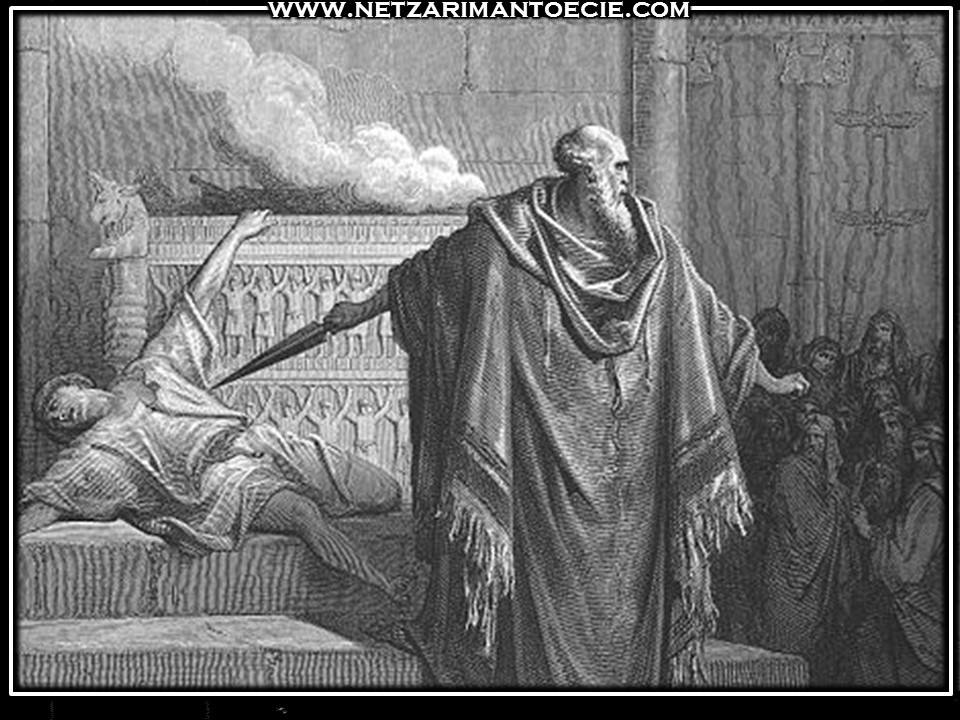
“But Mattathias answered and said in a load voice: ‘Even if all the nations that live under the rule of the king obey him, and have chosen to do his commandments, departing each one from the religion of his fathers, yet I and my sons and my brothers will live by the covenant of our fathers. Far be it from us to desert the law and the ordinances. We will not obey the king’s words by turning aside from our religion to the right hand or the left.’ When he had finished speaking these words, a Jew came forward on the sight of all to offer sacrifice upon the altar in Modein, according to the king’s command. When Mattathias saw it, he burned with zeal and his heart stirred. He gave vent to righteous anger; he ran and killed him upon the altar. At the same time he killed the king’s officer who was forcing them to sacrifice, and he tore down the altar.” (1 Maccabees 2:19-25)

(Slide)

“Then Mattathias cried out in the city with a loud voice, saying: ‘Let everyone who is zealous for the law and supports the covenant come out with me!’ And he and his sons fled to the hills and left all that they had in the city.” (2 Maccabees 2:27-28)

Many other Jews who were seeking righteous fled into the wilderness and lived in caves. Eventually, Officer’s from Antiochus’ garrison and additional forces sought them out and encamped opposite them, trying to negotiate their return if they would discard the Torah. The Jews refused and they were slaughtered on the Shabbat, refusing to defend themselves and profane the holy day.  When Mattathias, his sons, and his growing army of followers heard of the slaughtered, they vowed to defend themselves if they should ever be attacked on the Shabbat, lest no-one would be left alive who upheld the Torah. 

(Slide)

After this a mighty warrior class of Israelite called the Hasideans joined Mattithias and his followers and they became fugitives, tearing down pagan altars wherever they went and circumcising any male child they found. Word quickly spread to Antiochus of this growing threat and he begun to send large armies to pursue and kill them. Soon Mattathias grew old and passed on his leadership to Judah Maccabee. Upon his death, Mattathias blessed Judah and he became valiant warrior who killed and took the sword of Apollonius, the governor of Samaria who oversaw the large force that was assembled to quell the uprising. 

At one point, one of Judah’s comrades remarked,

(Slide)

“‘How can we, few as we are, fight against so great and strong a multitude? And we are faint, for we have eaten nothing today.’ Judah replied ‘It is easy for many to be hemmed in by few, for in the sight of Heaven there is no difference between saving by many of by few. It is not on the size of the army that victory in battle depends, but strength comes from Heaven. They come against us in great pride and lawlessness to destroy us and our wives and our children, and to despoil us, but we fight for our lives and laws.’” (3 Maccabees 3:17-21)

(Slide)

From victory to victory the Maccabees kept pushing and Antiochus became greatly destressed, having exhausted his funds. He sought to raise funds from other nations to assemble a great and heavy force and marched it against Jerusalem, but again Judah and his men prevailed. 

Finally, Judah and his forces came upon the Temple, which had been desecrated so badly, that it was barely recognizable. Summoning all their strength, they cleansed it, made a makeshift menorah and rededicated it. The Talmud says that during the cleaning only one veil of kosher oil was found, enough to light the menorah for only one day, seven days short of the time it should burn when the Temple is dedicated. 

(Slide)

Shabbat 21b: "Our rabbis taught:  On the 25th day of Kislev begin the eight days of Chanukah, on which lamentation for the dead and fasting are forbidden.  For when the Greeks entered the Temple, they defiled all the oil in it, and when the Hasmonean dynasty prevailed over them and defeated them, they searched and found only one bottle of oil sealed by the High Priest.  It contained only enough for one day's lighting.  Yet a miracle was brought about with it, and they lit (with the oil) for eight days.  The following year they were established as a festival, with Hallel and Thanksgiving."

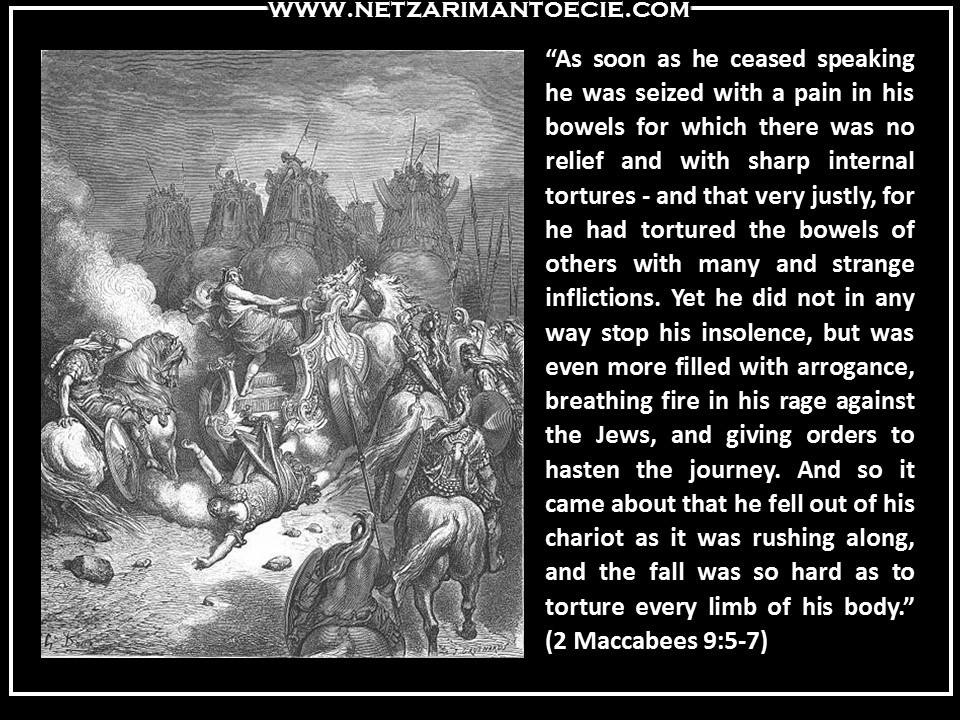
Around the same time when Antiochus was on campaign in Persia and forced into retreat he received news of his armies defeat against the Jews. He directed his charioteer to make flight to Jerusalem where he boasted he would make it a cemetery of Jews.

(Slide)

“As soon as he ceased speaking he was seized with a pain in his bowels for which there was no relief and with sharp internal tortures - and that very justly, for he had tortured the bowels of others with many and strange inflictions. Yet he did not in any way stop his insolence, but was even more filled with arrogance, breathing fire in his rage against the Jews, and giving orders to hasten the journey. And so it came about that he fell out of his chariot as it was rushing along, and the fall was so hard as to torture every limb of his body.” (2 Maccabees 9:5-7)

Eventually Judah Maccabee fell in battle, but not before securing Jerusalem and winning freedom over the enemies of the Jews. 

Chanukah in the Torah

Now, that was a crash course in the story of Chanukah. Now, for its appearance in Scripture. 

Chanukah is mentioned in the Torah, yes, even before the event even occurred.

(Slide)

The twenty-fifth Hebrew word in the opening of the Book of Genesis is ohr, which means “light” and we begin lighting the Chanukah lights on the 25th day of the month of Kislev, the same day that the Temple was dedicated after the victory of the Maccabee forces against the Syrian-Greeks.

(Slide)

When Israel travelled in the desert, on their way from Egypt to the land of Israel, the twenty-fifth place that they camped (“rested”) was Chashmonah. This alludes to the priestly family of Chashmonaim (Hasmoneans), who led the Maccabee armies in the battle against the Greeks, and who rested on the twenty-fifth day of Kislev. The first part of the word Furthermore, Chanukah is made up of two parts: “Chanu” which means “they rested” and the second part, “kah,” which means “25.”

The 23rd chapter of Leviticus describes the different Hebrew holidays. Immediately afterwards, at the beginning of chapter 24, we find the commandment to light the menorah in the Temple. This is a hint to a holiday connected to the lighting of the menorah.

Every tribal leader brought an offering to dedicate the Tabernacle, accept the tribe of Levi. The Midrash tells us that Yahweh told Moshe to tell his brother A’aron—the high priest, head of the Levites, and ancestor of the Maccabees—not to worry: sacrifices will last only as long as the Temples stands, but the lights will be lit forever. The lights of the Chanukah menorah that your descendants will initiate will continue to illuminate the darkness even after the destruction of the Temple.

The 7th and 8th chapters of Leviticus also hold a connection to the Chanukah Menorah. These describe the offerings and the lighting of the menorah. The light of the menorah is cast forward, not backward, but forwards hinting at something that was to come – Chanukah.

How to Observe Chanukah

  1. Learn about the holiday. ... 
  2. Get a Hanukkiah. ... 
  3. Recite the blessings when you light the Hanukkiah, or Menorah. ... 
  4. Play dreidel. ... 
  5. Give small tokens to children. ... 
  6. Eat foods cooked in oil. ... 
  7. Practice Tikkun Olam.

PDF Downloads

PDF with Slides
PDF No slides

If this teaching or any other teachings have been a blessing to you please consider our congregation for donations and offerings. 
All our teachings are free and as such rely on the generosity of our community. 

Thanking you from Nazarenes of Australia.

Donations

Comment

The Truth About Spiritual Leadership

Comment

The Truth About Spiritual Leadership

Video Teaching


Audio Teaching


Study notes and Slides

The Truth About Spiritual Leadership

Introduction

Over the past month I’ve been sharing with you regarding some of the anomalies within the text of the Torah and how these apparent mistakes serve as a type of vertical descent into what the Torah is teaching on a deeper level. You’ve heard how the French Medieval Sage Rashi devoted his life to compiling commentary dedicated to unravelling these countless anomalies.

For in the Torah, there are such things as seemingly unnecessary repetition, addition or subtraction of letters in words, enlarged or diminished letters, spacing of texts, you name it, it’s there, causing much pain to a translator unfamiliar with the Jewish Oral tradition. A tradition that should flow as an irreplaceable support to the text itself, both for compiling a Torah scroll and studying it.

For example, verses 35 & 36 in Numbers 10 are offset by two back-to-front Hebrew Nuns that separate theses verses from the rest of the text. One of the reasons given for this, is that these verses constitute two additional hidden books of the Torah, making a total of seven Books of the Torah instead of five. This is why Solomon writes, “But those who fail to find Me harm themselves; all who hate Me love death. Chochmah [wisdom] has hewn out her seven pillars" (Proverbs 8:36-9:1)

But not only do anomalies inhabit the text of the Torah itself, they should also be evident in a Torah adherent lifestyle. One of the reasons I disdain Jewish criticism of Yahshua, when they critic him and his ministry within the correct cultural and mission context, is because they’re own tzaddikim of past generations also carry a plethora of seemingly questionable actions and advice themselves, that when studied on a deeper level are sound. We see them seemingly breaking Halacha, seemingly desecrating Shabbat and giving very questionable instructions to students. Even Scripture itself has Solomon give an order to have a baby cut in half and Avraham attempting human sacrifice. 

If we study the requirements of what makes a person pleasing to Yahweh Elohim, whether they be a prophet, a king, a priest, a leader or even a common foot soldier, we find some very interesting things. In particular, the office of leadership carries a requirement that might surprise you. 

Leadership and its Strange Requirement

Our subject today is the truth about leadership within the household of faith. When it comes to leadership in matters of Torah, our first chief reference is none other than the greatest prophet who ever lived, Moshe Rabbeinu.

And here in lies possibly one of the greatest anomalies in Scripture. Why? Well, when he look at the attribute of modern leaders today, even within religious movements, we see the chief characteristic that Moshe possessed being all but devoid in them all. What characteristic is this? Humility. 

The Torah tells us something very interesting about Moshe. That he was the most humble of all men. This is a big statement, especially when it pertains to the role of leader. 

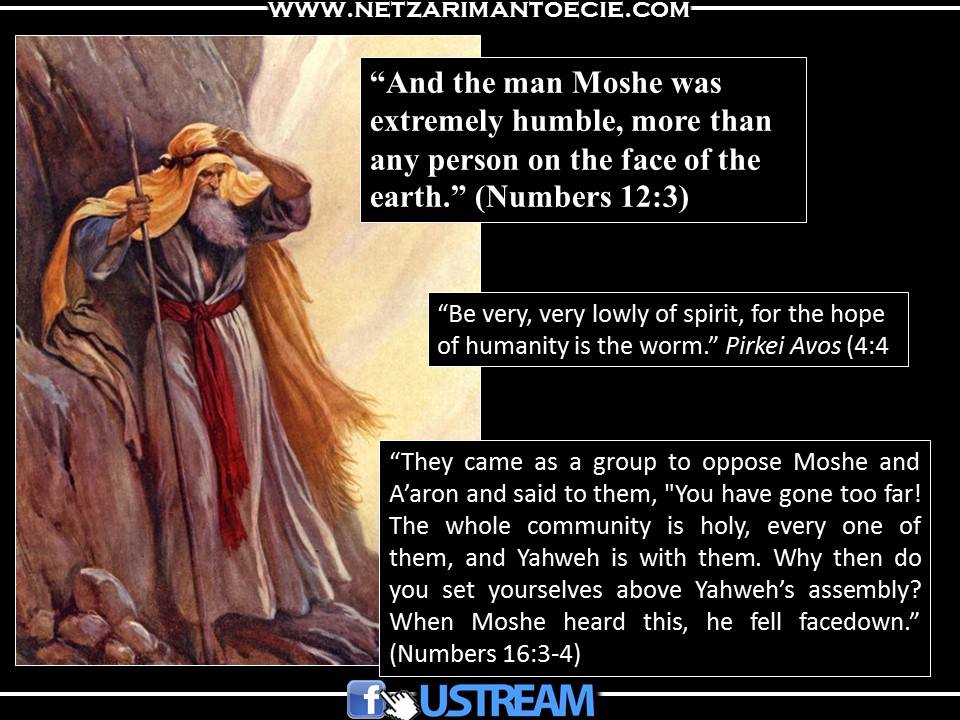
And the man Moshe was extremely humble, more than any person on the face of the earth.” (Numbers 12:3) The trait of humility is seeing yourself as being less than other men. 

In other words, the person who brought Israel out of Egypt, who split the sea for them, and received the Torah from Heaven considered himself smaller than everyone else.

The Torah is telling us that the greatest of all leaders was the humblest of all men who ever lived. From a Western standpoint, such a statement cannot be more counter intuitive than this. 

If we look at how our society and culture depict strong leaders, such things like boldness, decisiveness and unwaveringness come to mind. Our movies, corporations, electorates and athletic spheres do not in any way portray humility as being a chief attribute for fulfilling the role of leadership in any of these areas. Today humility is associated with weakness and ineptitude. But in Torah, humility is not considered a sign of weakness, rather it is looked upon as being instrumental. It’s not looked upon as being an admiral trait either, but as an essential tool for all who aspire to attain the quality of great leadership.     

Arrogance, something we’ve seen in the latest American presidential election from both candidates, is actually a trait that inhibits would-be followers from really getting behind and trusting and respecting these individuals.

The Hebrew word for “humility” is עֲנָוָה  Anavah from Anav, which means “lowly.” Anavah is not the opposite of self-esteem. It does not mean self-deprecation! It is the opposite of pride. It’s not about thinking less of yourself, but thinking about yourself less!  

The patriarch Avraham showed deep humility when he protested before Elohim saying: “Behold now, I have taken upon me to speak to Yahweh, who am I but dust and ashes” (Genesis 18:27) And even Saul, the first King of Israel was discovered “hid among baggage” when he was selected to be king in 1 Samuel 10:22. And yet what killed Saul? Arrogance, fueled by ego. What saved David? Humility, when he was found out about his transgression with Bathsheva in 2 Samuel 12:13 where he said, “I have sinned against Yahweh.” Elsewhere, David had several lawful opportunities to kill Saul who intended to kill him, but refused to do so out of respectful humility. When Shimei son of Gera hurtled stones, kicked up dust and insulted David as he fled Yerushalayim, the King refused to kill him saying, “if he is cursing because Yahweh said to him, ‘Curse David,’ who can ask, ‘Why do you do this?’” (2 Samuel 16:10)

Sha’ul showed humility when he said, “Here is a trustworthy saying that deserves full acceptance: Messiah Yahshua came into the world to save sinners—of whom I am the worst.” (1 Timothy 1:15)

All leaders of Israel were commanded to conduct themselves in a spirit of humility. The traits we often associate with high office, such as haughtiness, condescension and entitlement are to be avoided at all costs with those who are in power.


Rabbi Louis Jacob’s wrote: “Greatness and humility, in the Jewish tradition, are not incompatible. They complement one another….The greater the man the more humble he is expected to be…The Torah, say the rabbis (Taanit 7a), is compared to water for just as water only runs downhill, never uphill, the word of Elohim can only be heard in a humble heart.”

A would-be leader once came to a great rabbi with a complaint. “All my life,” he said, “I have tried to follow the advice of the rabbis that one who runs away from fame will find that fame pursues him, and yet while I run away from fame, fame never seems to pursue me.” The great rabbi replied: “The trouble is that while you do run away from fame you are always looking over your shoulder to see if fame is chasing after you.”

The Power of Humility

No human leader is flawless. Rather than create a false persona of perfection in leadership, the Torah sets the standard of “The Humble Leader.” A leader’s vulnerabilities should enhance his effectiveness in leadership. Failure is transcended by its own acknowledgement.

There is a saying in the Jewish writings that goes,

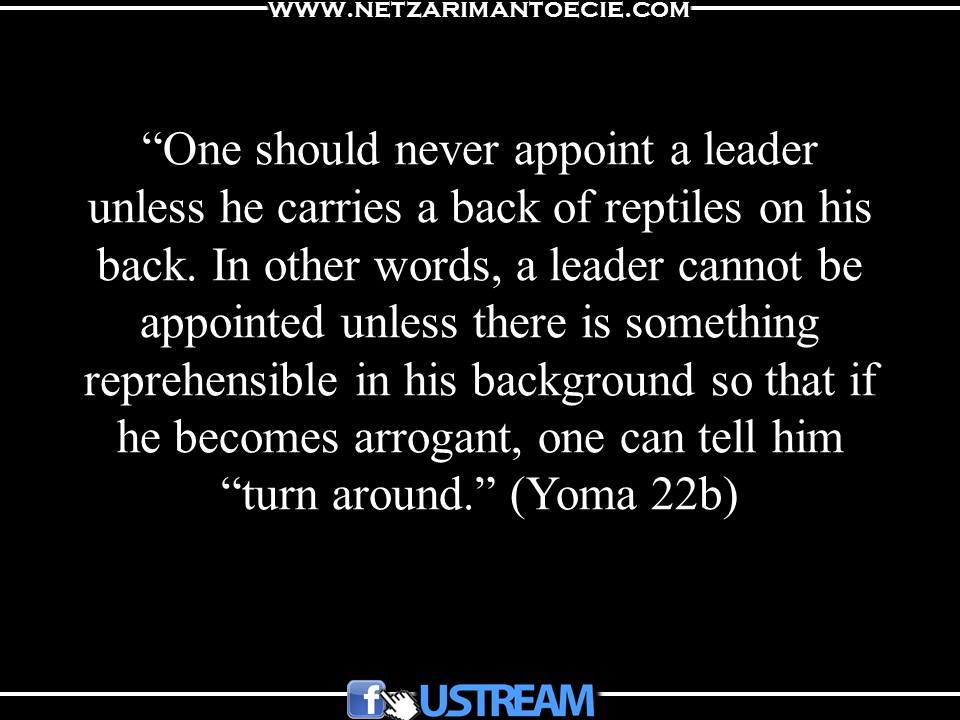
“One should never appoint a leader unless he carries a back of reptiles on his back. In other words, a leader cannot be appointed unless there is something reprehensible in his background so that if he becomes arrogant, one can tell him “turn around.” (Yoma 22b)

This insight gives us clarity to a popular verse.

“Brothers and sisters, if someone is caught in a sin, you who live by the Spirit should restore that person gently. But watch yourselves, or you also may be tempted.” (Galatians 6:1) In other words, when dealing with a transgressor, be very careful. Deal with him in a manner that is tailored to restore him. Turn around and see that you are no better, lest you be tempted to fall prey to arrogance. 

Leaders are expected to lead as human beings. Why? Because we can identify with them. The Creator of the Universe chose to relate to man with what? A man! A human being, the son of a man! King Messiah Yahshua was a human being born of a woman. He was 100% human. He never sinned, but his life was not devoid of trouble. He was born as a human being through the line of Judah subject to the tug-of-war between the yetza-hara (evil inclination) and the yetrza-tov (good inclination). His spirit coming through the outpouring the Ruach itself was encased in a body of flesh, a weaker perishing vessel.

“Watch and pray so that you will not fall into temptation. The spirit is willing, but the flesh is weak.” (Matthew 26:41) Yahshua knew that subjecting himself to a low state disarmed the power of the yetza-hara. All the propensities for the iniquities that plagued his ancestor, of the progenitor of the tribe of Yehudah – Judah would gain no foothold over him if he remained a humble servant.

“And one who was a nobleman asked (Yahshua) and said to him, “Good teacher, what shall I do to inherit eternal life?” Yahshua said to him, “Why do you call me good? There is no one good except the one Elohim.” (Luke 18:18-19) Yahshua, despite being given everything under his feet (1 Corinthians 15:27) always subjected himself to the lowest of states in all his dealings even refusing to accept an acknowledgment that he was a good man.

“In your relationships with one another, have the same mindset as Messiah Yahshua: Who, being in very nature Elohim, did not consider equality with Elohim something to be used to his own advantage; rather, he made himself nothing by taking the very nature of a servant, being made in human likeness. And being found in appearance as a man, he humbled himself by becoming obedient to death-- even death on the tree! (Philippians 2:5-8)

No-one can help another person unless he becomes like that person, unless he takes on that person’s weakness.

“Therefore, since the children have flesh and blood, He too shared in their humanity, so that by His death He might destroy him who holds the power of death, that is, HaSatan, and free those who all their lives were held in slavery by their fear of death. For, truly, (Yahshua) did not come to help the angels, but to help the offspring of Avraham. For this reason he had to be made like them, fully human in every way, in order that he might become a merciful and faithful high priest in service to Elohim, and that he might make atonement for the sins of the people.” (Hebrews 2:14-17)

What does it take to be a successful leader? The sacrifice of one’s ego and the elevation of humility. Ego, arrogance and pride obliterate one’s effectiveness. St. Augustine of Hippo (354-430 A.D.) wrote, “Pride is the commencement of all sin' because it was this which overthrew the devil.”

“Your heart became proud on account of your beauty, and you corrupted your wisdom because of your splendour. So I threw you to the earth; I made a spectacle of you before kings.” (Ezekiel 28:17)

What Elohim desires most in us, especially in leaders, is not outward sacrifices but a humble spirit according to Psalm 51:17 and Micah 6:8.  

“Be shepherds of Elohim's flock that is under your care, watching over them--not because you must, but because you are willing, as Elohim wants you to be; not pursuing dishonest gain, but eager to serve; not lording it over those entrusted to you, but being examples to the flock. (1 Peter 5:2-3)

“If my people, who are called by my name, will humble themselves and pray and seek my face and turn from their wicked ways, then I will hear from heaven, and I will forgive their sin and will heal their land.” (2 Chronicles 7:14)

“Take my yoke upon you and learn from me, for I am gentle and humble in heart, and you will find rest for your souls.” (Matthew 11:29)

Humility is about taking up the appropriate amount of space and to grow the leadership of others. A leader is to become Tzimtzum, to contract oneself to elevate others. 


PDF Downloads

PDF with slides
PDF no slides

Comment