Viewing entries in
General Teaching

Mission to the Northern Kingdoms (Netzarim Antoecie Missions work)

Comment

Mission to the Northern Kingdoms (Netzarim Antoecie Missions work)

Video Teaching


Audio Teaching (Downloadable)

Netzarim Antoecie Misson to the Northern Kingdoms

Study Notes and Slides

Mission to the Northern Kingdoms
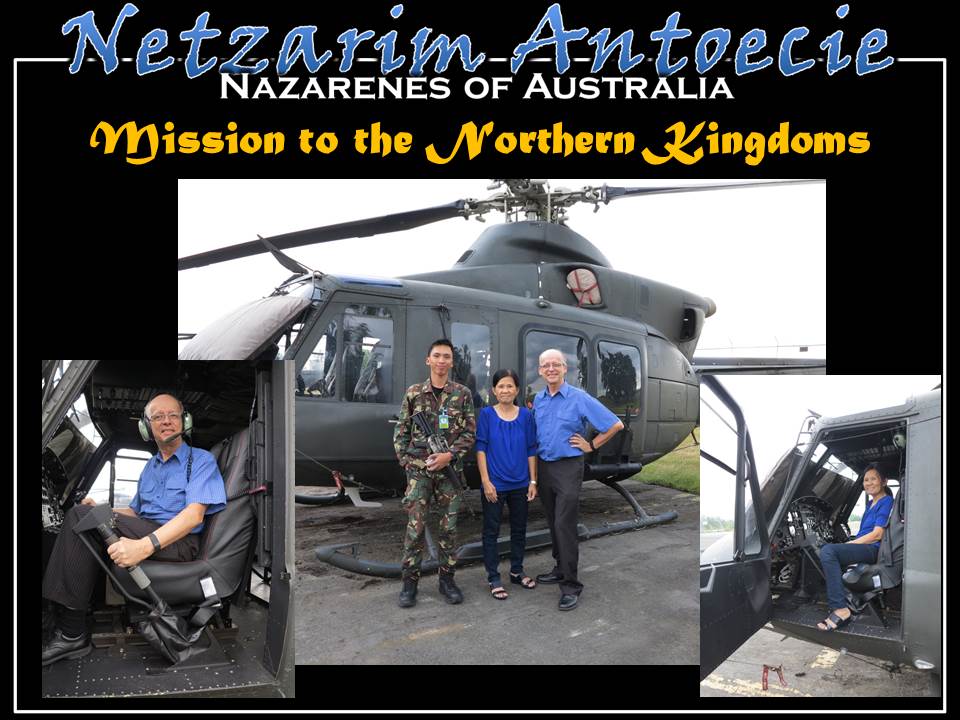
Introduction: It has been our delight for a long time to believe that one of our prime Missions in life is to bring encouragement, hope and truth to the many places we have felt called to go. This requires prayer, resources and an expectation that YHWH will open to us opportunities to minister and touch lives. Surely as Netzarim the desire to share the truth should always be a smouldering fire within our heart that should never go out. More than our hope we were asked to conduct a Conference that at its heart would primarily focus on the Netzarim faith though it was referred to as the Hebrew Roots but lets not split hairs. This seemed like a rather big challenge as we know how our teachings would be received among the Christian Churches where we all live.

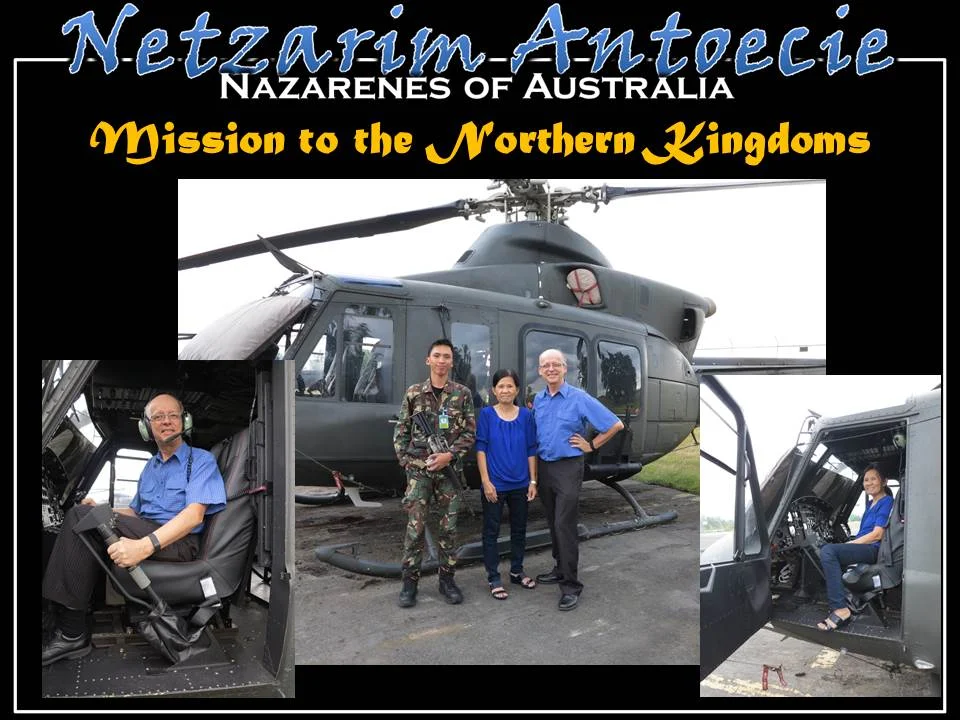
The first part of our Mission included an invitation to preach at an Airforce base in Cebu but we were also trying to contact a pastor friend on an Island north of where we were however no contact seemed to be forthcoming so I emailed him knowing that these people have no home internet and responses often take ages. Amazingly we prayed on a Thursday morning and that day the Pastor felt he needed to read his email at an internet cafe so we were able on the last day of the week to attend his Congregation which had moved to within an hour of where we were staying. You can see his new Congregation in the pictures which by then was only one month old. We did share and pray with him and I shared a bit regarding some area of our faith as well and promised to bring him a Tallit next visit as he truly understood from my explanation the spiritual blessing that it imparted. While praying for this couple I covered them with a tallit and truly felt an anointing of the Ruach (Spirit) as we petitioned the Heavenly Father. Upon that weekend we ministered in the Airforce base and stayed with a high ranking officer belonging to the Congregation who organized with the Commander that we had a gate pass. This particular man we had stayed with before and since I had three years ago encouraged him to study the Hebrew he was well on his way to believing much of what we believe.  

This Congregation had a vibrant worship with the young people participating. Though I preached that Sunday I gave a message to encourage people that to be set-apart for Yahweh it is not just about faith but about living a Holy set-apart life which relates to obedience to his word as we begin to understand it. 
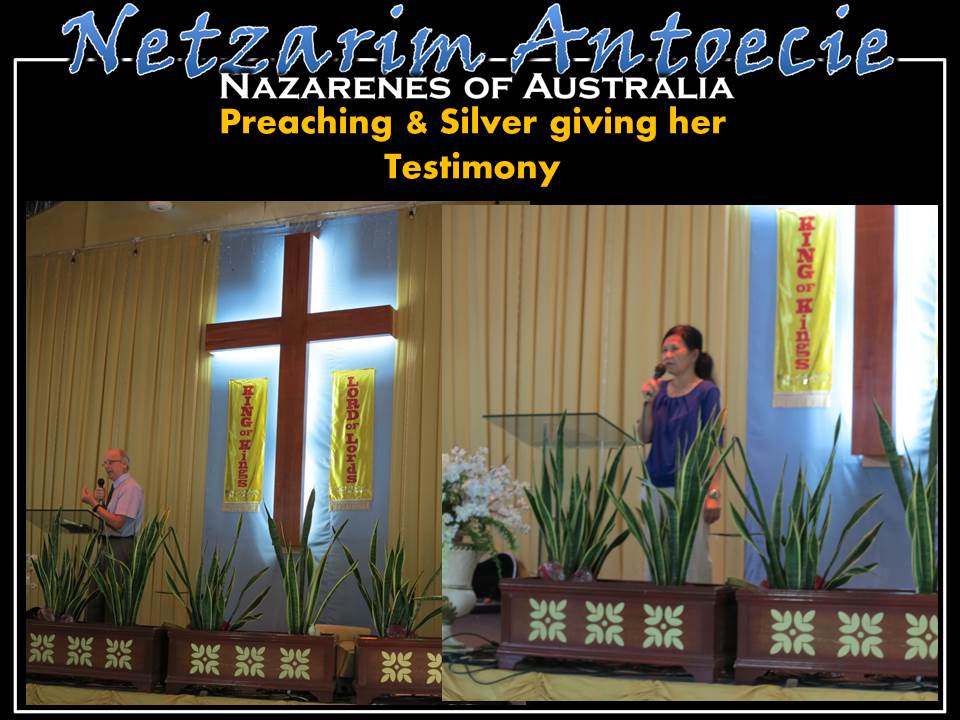
 I was naturally subtle in my approach and at the end I gave Silver the opportunity to share some interesting testimony of her life as a refugee escaping a highly controlling Regime in Vietnam to live for three years in a refugee camp in the Philippines after a harrowing life and death experience at sea concluding with Silver and I praying for a number of people one in particular with stage 3 or 4 cancer encouraging them that YHWH is merciful. 

The Two Day Conference at Iloilo Philippines

Stage 2 of our Mission Journey was to hold two days of teaching on the Hebrew roots of the faith, Sabbath, the Feasts of Yahweh as well as Hanukkah to people from many Christian Congregations including a number of Pastors. Even my Pastor friends who had circulated invitations were surprised how many had come but on our posters they had not mentioned Sabbath so at the end of the first day which finished with the teaching on Shabbat I wondered how many would return the next day. To our amazement though the numbers were slow at filling they finally came with up to about 70 people in attendance. I was told that a number of Pastors had raised many questions on the Fall Feasts but fortunately at the end of my teaching many of their questions had been answered. To think that here were strictly Christians being taught the truths from scripture that went against tradition and that they were happily receiving it was truly a blessing and I have come to realise that Yahweh is doing something great is the Philippines by breaking down many walls like he did in our life. 

The next Shabbat I was also able to lead and demonstrate the entire Netzarim Liturgy but I also sang for them the songs within the liturgy as we had no music but even that went rather well even if I do say so myself. All in all it was a blessed experience.

Conference in Baguio City Philippines
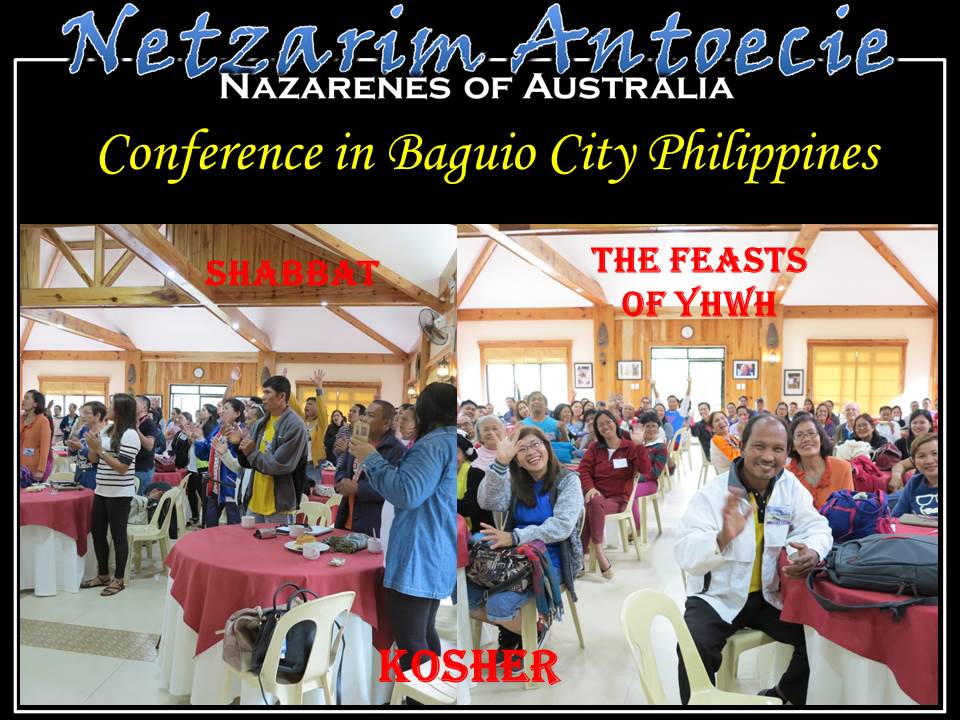
Following this experience we had been invited to a major Conference in a City that would take a six hour bus trip to reach from Manila. Many of these people that came were rather poor and had to beg and scrap to come but they did, as it required a Plane & Bus trip, as well as Hotel accommodation for three days. Amazingly this Conference comprised at least 150-200 Pastors from all over the Philippines and had as its itinerary teaching revolving around the Sabbath, Kosher and the keeping of the Biblical feasts. 


It was so great to see a group of Christian Pastors passionate about blowing the Shofar and living in obedience to Torah though that was a process as we saw. They did lack knowledge but had the heart and were on the road for example of transforming from Sunday worship to the Sabbath. A wonderful example of that was a couple from an island in which Silver had lived in a Refugee camp. These had begun with two services and now they tell us that the Sunday service has 15 people while the Sabbath service had about 70 which is truly remarkable. 

I had also been asked to teach one session and the Organizer had asked if I could teach on Sabbath which I did. As I saw the heartfelt desire to break tradition I knew that the Spirit of Yahweh was doing something in the Philippine that is totally unprecedented. When I finished my talk I began to feel like a Celebrity as people were asking me to write down the Hebrew morning prayer that we recite and those sleeping in the Dorm said they all joined in that prayer the next morning. 

This has become a yearly Conference and I believe it is changing the face of the Churches and you can see we had a mighty photo shoot at the end of the Conference.

One experience of Significance during this time was when some different couples had spoken to Silver about a special need they had so Silver organized for them to be prayed for but not right then. One couple was to come to our apartment at 4 am and one at 5 am. As this place is high in the mountains it was rather cold but only the 5 am couple came all dressed in snow gear and we had a wonderful time of prayer and even blew the Shofar at that time but seeing the faith and passion of these people was great though following thatthe other couple truly got a roasting from Silver after which they repented because Silver rebuked them and said that since they are Pastors no matter what they should keep to their word. 

The Red Carpet Treatment
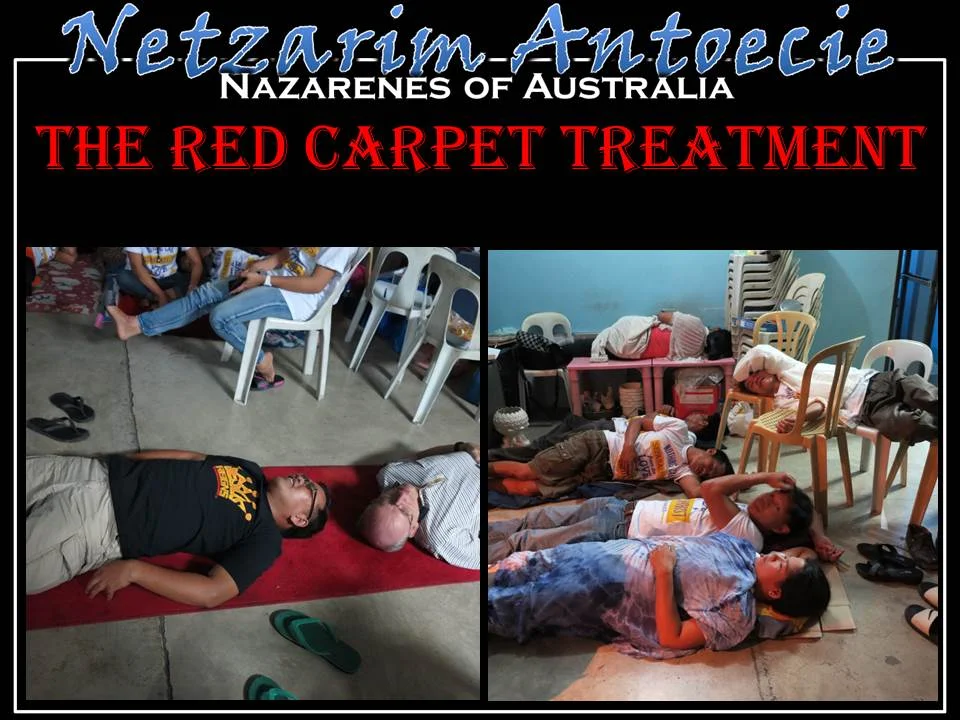
Upon returning to Manila we decided to stay with the rest in the Church though we had been offered better accommodation. This is Mission life, experiencing whatever the local people experience so we were happy to join with them sleeping on cardboard or the carpet as uncomfortable as that might seem just to fellowship with them. 

The following day we at least were able to join together in a Shabbat service in which I used our Liturgy so that was a great blessing again.


 After one night we did go to a Hotel for the weekend and had the Helicopter Pilot pick us up for Church on Sunday and we visited a Victory Church not unlike Hillsong. However as often happens Silver felt the Man in front of us needed pray so she asked them, only to discover that two days prior to that he had been diagnosed with a heart condition and was depressed. How she knew that she will tell you is a gift from YHWH. It was interesting also that he was a retired Pastor so through prayer we know his spirit and faith were lifted. 

Stage 4- Vietnam Visit

 As we all know Vietnam is under a Communist Government so we had no idea what to expect. However this is Silvers old stomping ground and we did have accommodation with a cousin who also picked us up at the airport. 


Since it was Chinese and Vietnamese New Year we could experience all the fan fair and decorations which were quite elaborate in Ho Chi Minh City. It was also Silver’s desire to visit people she had done business with over 37 years ago, before she escaped Vietnam as a Refugee but what was most striking was the masses of Motor bikes that flooded the roads with no apparent care for rules. It appears that this place ran by organised Chaos where everyone did what pleased themselves. 


As we were aware that some Filipinos had come to Ho Chi Minh from the Church in Cebu we made contact as we like most people thought that Churches were not allowed but to our surprise we discovered that times had begun to change and where they worshipped was an approved Church that housed a Philippine, Vietnamese, Korean & western Congregation though formerly the Filipinos had been confronted by the Police for meeting in a Coffee shop and had been detained by the Police.

We also had the opportunity of meeting the Vietnamese owner & Pastor of the Building & Silver again had the opportunity to Pray for her. 

During our time there, Silver did have the opportunity to see how her friends of many years ago lived and see their Business which was still quite active and successful which brightened her day.  

Through that Church we were also able to make contact with another Pastor & visit her small Church near where we stayed so we could fellowship and again pray with some.

The Kingdom of Cambodia

Our final destination was the Kingdom of Cambodia and many of us recall the horrific scenes of the killing fields that had made Pol Pot that villain General Infamous. We may not know that he emptied the City of Phnom Penh of people who had to try to live in the country with many dying so he could loot the entire city. Fortunately those days are past and Cambodia is developing much but we discovered that things do not change much. Hun Sin is the Billionaire President and we heard that he had just recently declared all opposition parties Criminals imprisoning some making his Country a one party state but at least there is peace. 

 

A Tuk Tuk

Market Stall

Temples in Phnom Penh

We were able in this visit to experience the life that Silver had left behind as a young Kid and see how things had changed yet still stay the same for many. A typical Fish or Butcher shop is shown in the Slide and according to our standards it does not look too hygienic. Fortunately a bowl of noodles or general plate of Cambodian food would only cost about $1:50 US and our Hotel was only about $20 per night though Silver was able to haggle the price down to $17 good for her. 

Q 17.JPG

Most importantly we were able to visit some Churches speaking with the young to encourage them after which we made contacts with a Mission helping the Poorest. Through that contact we gained accommodation for an additional week though it was quite hot and we had only a weak fan and a quilt as a mattress so I used a pillow under my back and sometimes slept on the floor as the floor tiles gave me some relief from the incessant heat. 
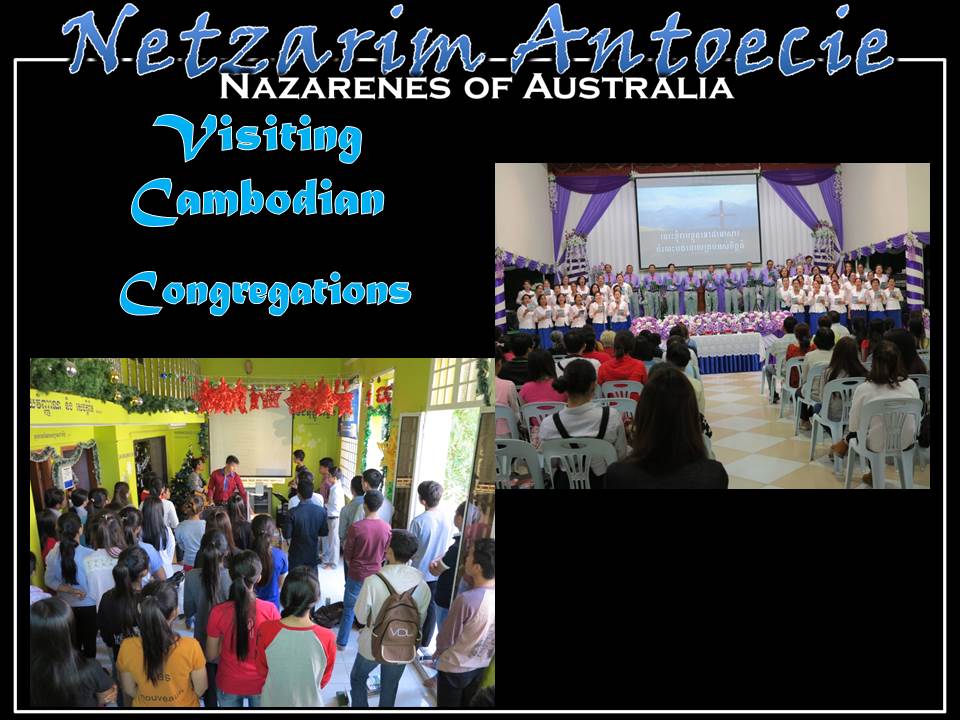
We were also invited to an outreach in the Country where we were able to pray for many and experience some fellowship but sadly after the meal by the next day I did have a bout of diarrhoea which was not too good so I had to be careful what I ate but fortunately we had some Japanese strong herds which finally helped. 

Journey to Siem Reap and Ankor Wat  

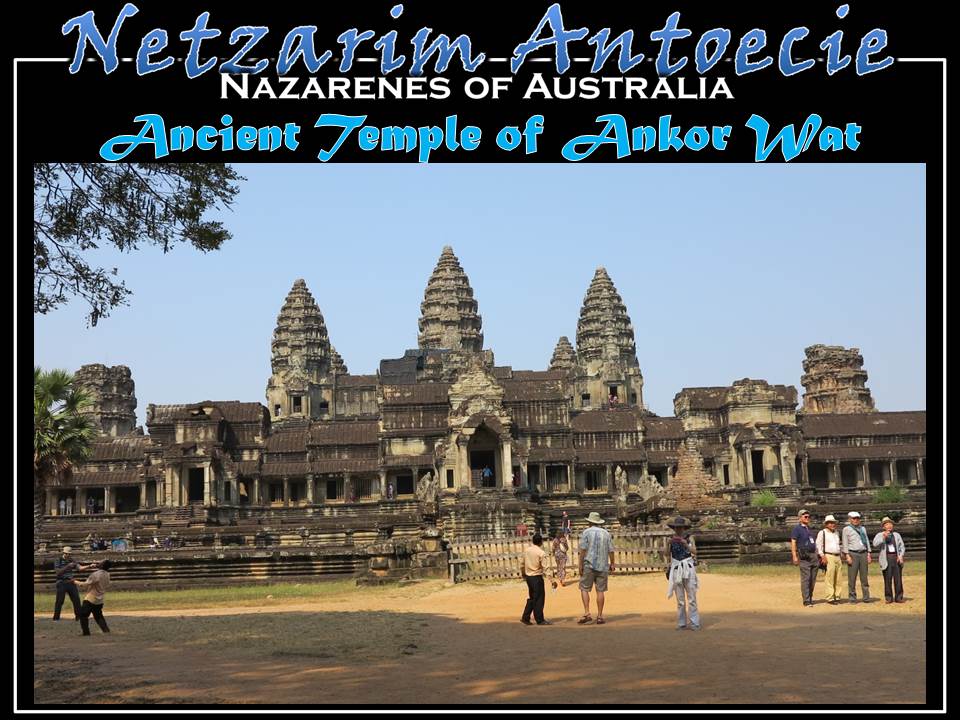
In the Final leg of the Journey we went to Siem Reap a City in the North about 6 hours by Bus. Fortunately Accommodation was only $12 per night and we organized to visit the Ancient Temples of Anchor Wat. As Silver speaks fluent Cambodian she was blessed in that she was given free entry to all the Tourist spots as they thought she was a local which saved us $37 each time we entered a site. This Temple was quite interesting also because listening to the Tour Guide we discovered some interesting facts. Its construction was quite amazing as it is called a floating Temple as engineers of 1000 years ago had to work out how to maintain the water table during the dry or it would shift. This they did by building a large moat around it. Apart from the huge numbers of workers & the Passion to build such great structures reflecting their Pagan faith not unlike the building of Sh’lomoh’s (Solomon’s) Temple there was a unique truth that goes back all the way to Ancient Babylon. Though it was considered a Buddhist Temple we were told it was actually a Hindu Temple as Buddhism originates from Hinduism. We were also informed that the Towers of the Temples were designed to line up with the Sun during the winter, Spring, Autumn and Summer Equinoxes as the basic belief revolved around the Sun which takes us back to Babylon and the Pagan Worship of the Sun which was prevalent.  
 

The Mission Truths Discovered

  1. We discovered that YHWH is moving mightily in the Philippines to bring many congregations to realize the need for Torah (Biblical) obedience. I hope we can be encouraged by this & not feel so isolated in our faith.
  2. The doors are opening wide to bring the full message of Salvation & Righteous living to a hungry people who are opening their hearts to the Shabbat, Kosher eating, the Feasts of YHWH and Torah living and we need to be ready & expectant when it happens here.
  3. Even in Vietnam that is under Communism a new wind is blowing that sees the message of the Saviour proclaimed freely in registered Congregations unhindered.
  4. The Trip to the Buddhist Temple of Ankor Wat revealed its Hindu origin but more striking is how its Towers were constructed to line up with the Sun on the Equinoxes revealing a deep seated Worship of the Sun which surely dates back to Nimrod & Babylon.   

PDF Downloads


If this teaching or any other teachings have been a blessing to you please consider our congregation for donations and offerings.
All our teachings are free and as such rely on the generosity of our community.

Thanking you from Nazarenes of Australia.

Comment

The Importance of the Question

Comment

The Importance of the Question

Video Teaching


Audio Download

Netzarim Antoecie The Importance of the right Question

Study Notes and Slides

The Importance of the Question


As supposed followers of Yahshua ben Yoseph HaNazaret A.K.A Yahshua HaMoshiach, I’m always astounded with the how little we still relate his teaching and conduct to the Jewish religion of his time and current orthodox Judaism today. There still exists a vast chasm of compartmentalised thinking that until bridged, is going to keep many Messianics from discovering so many more beautiful aspects of the Torah – essentially robbing people of seeing Messiah in a more exquisite depth. 

It’s not until I started looking into the importance of questioning in Judaism and how Yahshua responded to questions, often with counter questions or answers that invited even greater questions, that I started to see yet another facet of Judaism, which very much aligns with Messiah’s teaching during his brief ministry. 

You can’t truly appreciate who Messiah was and is unless you learn to appreciate his religion, Israel and the Land he walked on.  

Out of all the religions that existed in the second century, Judaism is the only one that has survived, and not only that, it’s remained somewhat surprisingly intact given the rough terrain that it’s had to traverse. Incidentally, Israel and the Land also still exist. Yet the predominant religion of the Western world that professes to follow Messiah, ignores his religion, ignores Israel and ignore the Land with almost finite precision. We must remember, that neither Yahshua or Sha’ul came to start a new religion, Israel were never forsaken and occupying the Land is a mandated aspect of Torah observance. Indeed the concept of the Promised Land is mentioned more times in Scripture than the concept of salvation. But I digress. 

At the close of Last Shabbat, I decided that we’d have a Q & A session, which over the course of the week got me wondering about the nature of questions, the strict precursor to all answers. There is no such thing as an answer, unless a question precedes it. 

So, a question came to me, that is, do people in our faith question things enough, do we question too much or do we question the wrong things?

Is asking a question a mitzvah? 

Is there really such thing as a silly Question?

It’s recorded that Messiah Yahshua answers at least 29 questions with a question. Why did he do this?

So as you can see, I had a lot of questions!

Let’s start at the beginning. 

(Slide) Many great men of Scripture questioned the Almighty, in fact it has been said that the greater the prophet, the harder the question. Avraham Avinu asked, ‘You could not possibly do such a thing: to kill the righteous with the wicked, treating the righteous and the wicked alike. You could not possibly do that! Won't the Judge of all the earth do what is just?"(Genesis 18:25) Moshe asked, “O Yahweh, why have you brought all this trouble on your own people? Why did you send me?” (Exodus 5:22) Jeremiah said, “‘You are always righteous, O Yahweh, when I bring a case before You, yet I would speak with You about Your justice: Why does the way of the wicked prosper? Why do all the faithless live at ease?’ (Jeremiah 12:1) Job, the one who searched most thoroughly for an explanation of why humans suffer, is full of questions, to which Elohim replies with four chapters of questions of His own. Some of the earliest recorded Jewish sermons (known as the Yelamdenu, which means “to inquire,” began with a question asked of the rabbi by a member of the congregation. One of the classic genres of rabbinical literature is called She’elot uteshuvot, which means ‘questions and replies.’ Pretty soon, I noticed that questioning is at the heart of all Torah learning. 

There are three types of questions. There are questions about chokhmah, ‘wisdom,’ which include scientific, historical, and sociological inquiry. There are questions about justice and questions about the Torah. These include the four questions asked of children at the Pesach Seder, which are: ‘Why is this night different? Why do we do this, not that? What is the reason for the law?’

The funny thing is, most questions get asked by small children. As a person grows into an adult, he can become somewhat complacent with his surroundings and asks fewer questions, either through an assumption that he might already know the answer or through disinterest. 

Children are characterised as being inquisitive beings. They constantly ask, ‘How’s that work?,’ ‘What’s that man doing?,’ ‘why is the sky blue?’ or ‘Where does rain come from?’ This is an inbuilt feature in normal healthy children and it is as much about enabling the child to learn as it is about enabling the parent to teach. 

The Torah emphasises the fact that children must ask questions.

(Slide) “What does this ceremony mean to you?’ then tell them, ‘It is the Korban Pesach to Yahweh, who passed over the houses of the Israelites in Mitzrayim and spared our homes when he struck down the Mitzrites.’” (Exodus 12: 26-27)

“In days to come, when your son asks you, ‘What does this mean?’ say to him, ‘With a mighty hand Yahweh brought us out of Mitzrayim, out of the land of slavery. When Pharaoh stubbornly refused to let us go, Yahweh killed the firstborn of both people and animals in Mitzrayim. This is why I sacrifice to Yahweh the first male offspring of every womb and redeem each of my firstborn sons.’ And it will be like a sign on your hand and a symbol on your forehead that Yahweh brought us out of Mitzrayim with his mighty hand.” (Exodus 13:14-16) 

“When your son asks you in a time to come, ‘What is the meaning of the testimonies and the statutes and the rules that Yahweh our Elohim has commanded you?’ then you shall say to your son, ‘We were Pharaoh's slaves in Mitzrayim. And Yahweh brought us out of Egypt with a mighty hand.’” (Deuteronomy 6:20-21)

Parents are commanded to provoke their children to be inquisitive in regards to the Torah, in fact the Torah itself is constructed in a way that requires constant questioning. By asking questions about parts of the Torah that don’t seem to make sense to a child or even an adult, depths of understanding are reached, and the temptation to just skim over the text is avoided, which causes the text to eventually be misunderstood or forgotten. 

Parents who graft themselves to the Commonwealth of Israel should pass on the memories and ideals of Israel to the next generation. The story of how Israel fought for its freedom and how the nation toiled in the face of great adversity, allow upcoming generations to be anchored from one generation to the next. It’s interesting how Israel is the only nation, having a faith based on constant question and answering, who have managed to maintain its heritage, while all other nations of the world have come and gone.  

The true faith of the Scriptures is not a religion of blind obedience. As odd as this may sound, amid the entire 613 commandments of the Torah, there is no Hebrew word that means “to obey.” In an attempt to standardise Hebrew with other languages in the nineteenth century, the Aramaic word le-tsayet, which means ‘to obey,’ was added as a seemingly much needed verb. However, the pure language of Scripture uses the verb shema, a word that is untranslatable into English because it means to listen, to hear, to understand, to internalise, and to respond all in one word!

Another amazing thing in Scripture is how the Word spread. Recipients of the Word of Yahweh came out to hear and they asked to join. Rarely do we have accounts of Yahshua or any of the his talmidim coaxing followers to join, rather, they made themselves as public as possible and just spoke and acted. Followers, whether they were Jews or converts, came to them and asked them if they could join. Sometimes, they were even knocked back. 

So why did Yahshua answer questions with another question and why did his religion put some much emphasis on asking questions? 

Ultimately, a rabbi or a teacher are not to answer questions like they’re on a game show. Their job is to discern the nature of the question being asked, and invariably they have an ability to ask a return question that provokes the enquirer to examine the motive of his original question. 

Now, contrary to popular belief, there is such thing as a silly question. Every question that the Pharisees asked Yahshua that was motivated to entrap him would certainly be considered silly.  

There are three conditions for asking questions related to Torah and Messiah. The first is that a person should be seeking to genuinely learn – not to doubt, ridicule, dismiss or reject. That is what the ‘wicked son’ of the Haggadah does: ask not out of a desire to understand but as a prelude to walking away. Second is that we accept limits to our understanding. Not everything is intelligible at any given moment.

The third is that when we come to receiving answers, we should be willing to do what these answers entail. For example, there is no way of understanding Shabbat without keeping Shabbat and no way of appreciating how family purity laws enhance a marriage without observing them.

Rabbi Lord Jonathan Sacks states, “…asking a question is itself a profound expression of faith in the intelligibility of the universe and the meaningfulness of human life. To ask is to believe that somewhere there is an answer. The fact that throughout history people have devoted their lives to extending the frontiers of knowledge is a compelling testimony to the restlessness of the human spirit and its constant desire to go further, higher, deeper. Far from faith excluding questions, questions testify to faith – that history is not random, that the universe is not impervious to our understanding, that what happens to us is not blind chance. We ask, not because we doubt, but because we believe.


PDF Downloads


If this teaching or any other teachings have been a blessing to you please consider our congregation for donations and offerings. 
All our teachings are free and as such rely on the generosity of our community. 

Thanking you from Nazarenes of Australia.


Comment

The Truth About Spiritual Leadership

Comment

The Truth About Spiritual Leadership

Video Teaching


Audio Teaching

Netzarim Antoecie The Truth About Spiritual Leadership

Study notes and Slides

The Truth About Spiritual Leadership

Introduction

Over the past month I’ve been sharing with you regarding some of the anomalies within the text of the Torah and how these apparent mistakes serve as a type of vertical descent into what the Torah is teaching on a deeper level. You’ve heard how the French Medieval Sage Rashi devoted his life to compiling commentary dedicated to unravelling these countless anomalies.

For in the Torah, there are such things as seemingly unnecessary repetition, addition or subtraction of letters in words, enlarged or diminished letters, spacing of texts, you name it, it’s there, causing much pain to a translator unfamiliar with the Jewish Oral tradition. A tradition that should flow as an irreplaceable support to the text itself, both for compiling a Torah scroll and studying it.

For example, verses 35 & 36 in Numbers 10 are offset by two back-to-front Hebrew Nuns that separate theses verses from the rest of the text. One of the reasons given for this, is that these verses constitute two additional hidden books of the Torah, making a total of seven Books of the Torah instead of five. This is why Solomon writes, “But those who fail to find Me harm themselves; all who hate Me love death. Chochmah [wisdom] has hewn out her seven pillars" (Proverbs 8:36-9:1)

But not only do anomalies inhabit the text of the Torah itself, they should also be evident in a Torah adherent lifestyle. One of the reasons I disdain Jewish criticism of Yahshua, when they critic him and his ministry within the correct cultural and mission context, is because they’re own tzaddikim of past generations also carry a plethora of seemingly questionable actions and advice themselves, that when studied on a deeper level are sound. We see them seemingly breaking Halacha, seemingly desecrating Shabbat and giving very questionable instructions to students. Even Scripture itself has Solomon give an order to have a baby cut in half and Avraham attempting human sacrifice. 

If we study the requirements of what makes a person pleasing to Yahweh Elohim, whether they be a prophet, a king, a priest, a leader or even a common foot soldier, we find some very interesting things. In particular, the office of leadership carries a requirement that might surprise you. 

Leadership and its Strange Requirement

Our subject today is the truth about leadership within the household of faith. When it comes to leadership in matters of Torah, our first chief reference is none other than the greatest prophet who ever lived, Moshe Rabbeinu.

And here in lies possibly one of the greatest anomalies in Scripture. Why? Well, when he look at the attribute of modern leaders today, even within religious movements, we see the chief characteristic that Moshe possessed being all but devoid in them all. What characteristic is this? Humility. 

The Torah tells us something very interesting about Moshe. That he was the most humble of all men. This is a big statement, especially when it pertains to the role of leader. 

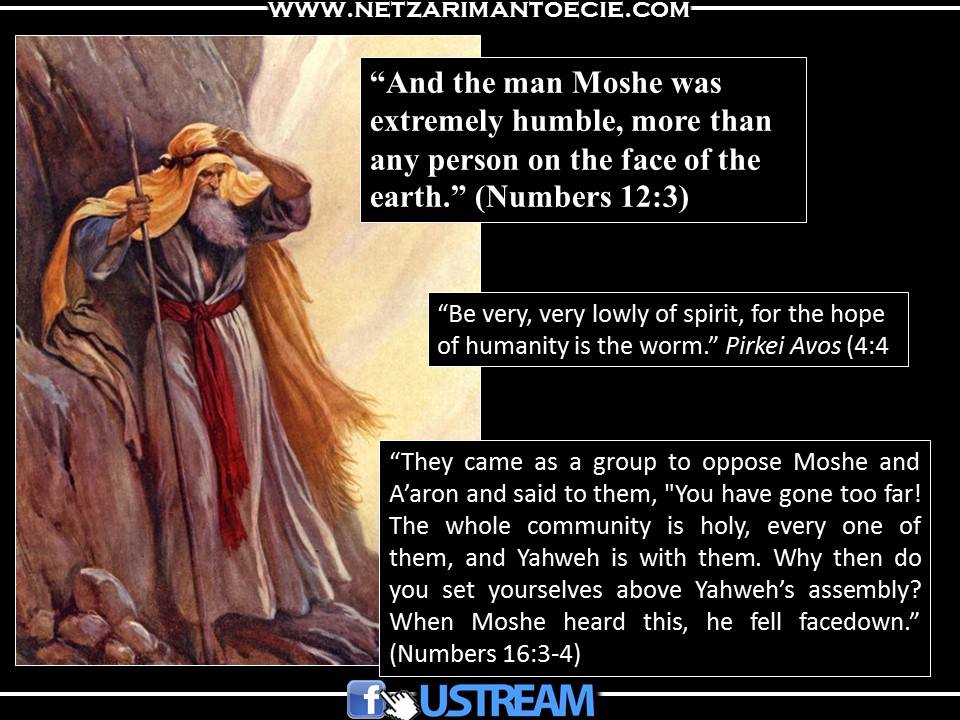
And the man Moshe was extremely humble, more than any person on the face of the earth.” (Numbers 12:3) The trait of humility is seeing yourself as being less than other men. 

In other words, the person who brought Israel out of Egypt, who split the sea for them, and received the Torah from Heaven considered himself smaller than everyone else.

The Torah is telling us that the greatest of all leaders was the humblest of all men who ever lived. From a Western standpoint, such a statement cannot be more counter intuitive than this. 

If we look at how our society and culture depict strong leaders, such things like boldness, decisiveness and unwaveringness come to mind. Our movies, corporations, electorates and athletic spheres do not in any way portray humility as being a chief attribute for fulfilling the role of leadership in any of these areas. Today humility is associated with weakness and ineptitude. But in Torah, humility is not considered a sign of weakness, rather it is looked upon as being instrumental. It’s not looked upon as being an admiral trait either, but as an essential tool for all who aspire to attain the quality of great leadership.     

Arrogance, something we’ve seen in the latest American presidential election from both candidates, is actually a trait that inhibits would-be followers from really getting behind and trusting and respecting these individuals.

The Hebrew word for “humility” is עֲנָוָה  Anavah from Anav, which means “lowly.” Anavah is not the opposite of self-esteem. It does not mean self-deprecation! It is the opposite of pride. It’s not about thinking less of yourself, but thinking about yourself less!  

The patriarch Avraham showed deep humility when he protested before Elohim saying: “Behold now, I have taken upon me to speak to Yahweh, who am I but dust and ashes” (Genesis 18:27) And even Saul, the first King of Israel was discovered “hid among baggage” when he was selected to be king in 1 Samuel 10:22. And yet what killed Saul? Arrogance, fueled by ego. What saved David? Humility, when he was found out about his transgression with Bathsheva in 2 Samuel 12:13 where he said, “I have sinned against Yahweh.” Elsewhere, David had several lawful opportunities to kill Saul who intended to kill him, but refused to do so out of respectful humility. When Shimei son of Gera hurtled stones, kicked up dust and insulted David as he fled Yerushalayim, the King refused to kill him saying, “if he is cursing because Yahweh said to him, ‘Curse David,’ who can ask, ‘Why do you do this?’” (2 Samuel 16:10)

Sha’ul showed humility when he said, “Here is a trustworthy saying that deserves full acceptance: Messiah Yahshua came into the world to save sinners—of whom I am the worst.” (1 Timothy 1:15)

All leaders of Israel were commanded to conduct themselves in a spirit of humility. The traits we often associate with high office, such as haughtiness, condescension and entitlement are to be avoided at all costs with those who are in power.


Rabbi Louis Jacob’s wrote: “Greatness and humility, in the Jewish tradition, are not incompatible. They complement one another….The greater the man the more humble he is expected to be…The Torah, say the rabbis (Taanit 7a), is compared to water for just as water only runs downhill, never uphill, the word of Elohim can only be heard in a humble heart.”

A would-be leader once came to a great rabbi with a complaint. “All my life,” he said, “I have tried to follow the advice of the rabbis that one who runs away from fame will find that fame pursues him, and yet while I run away from fame, fame never seems to pursue me.” The great rabbi replied: “The trouble is that while you do run away from fame you are always looking over your shoulder to see if fame is chasing after you.”

The Power of Humility

No human leader is flawless. Rather than create a false persona of perfection in leadership, the Torah sets the standard of “The Humble Leader.” A leader’s vulnerabilities should enhance his effectiveness in leadership. Failure is transcended by its own acknowledgement.

There is a saying in the Jewish writings that goes,

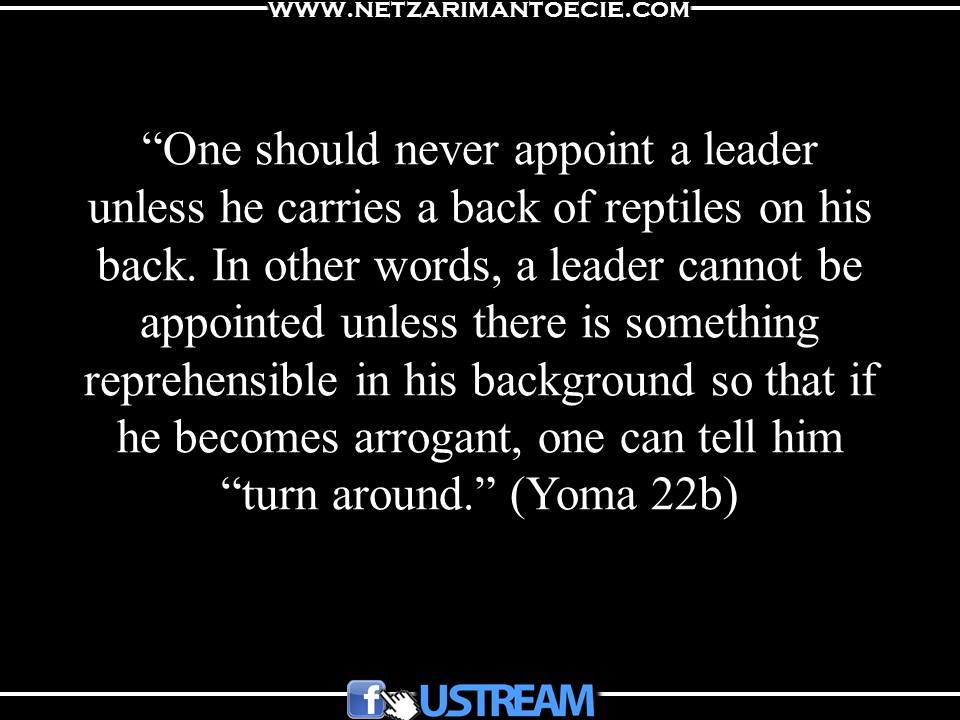
“One should never appoint a leader unless he carries a back of reptiles on his back. In other words, a leader cannot be appointed unless there is something reprehensible in his background so that if he becomes arrogant, one can tell him “turn around.” (Yoma 22b)

This insight gives us clarity to a popular verse.

“Brothers and sisters, if someone is caught in a sin, you who live by the Spirit should restore that person gently. But watch yourselves, or you also may be tempted.” (Galatians 6:1) In other words, when dealing with a transgressor, be very careful. Deal with him in a manner that is tailored to restore him. Turn around and see that you are no better, lest you be tempted to fall prey to arrogance. 

Leaders are expected to lead as human beings. Why? Because we can identify with them. The Creator of the Universe chose to relate to man with what? A man! A human being, the son of a man! King Messiah Yahshua was a human being born of a woman. He was 100% human. He never sinned, but his life was not devoid of trouble. He was born as a human being through the line of Judah subject to the tug-of-war between the yetza-hara (evil inclination) and the yetrza-tov (good inclination). His spirit coming through the outpouring the Ruach itself was encased in a body of flesh, a weaker perishing vessel.

“Watch and pray so that you will not fall into temptation. The spirit is willing, but the flesh is weak.” (Matthew 26:41) Yahshua knew that subjecting himself to a low state disarmed the power of the yetza-hara. All the propensities for the iniquities that plagued his ancestor, of the progenitor of the tribe of Yehudah – Judah would gain no foothold over him if he remained a humble servant.

“And one who was a nobleman asked (Yahshua) and said to him, “Good teacher, what shall I do to inherit eternal life?” Yahshua said to him, “Why do you call me good? There is no one good except the one Elohim.” (Luke 18:18-19) Yahshua, despite being given everything under his feet (1 Corinthians 15:27) always subjected himself to the lowest of states in all his dealings even refusing to accept an acknowledgment that he was a good man.

“In your relationships with one another, have the same mindset as Messiah Yahshua: Who, being in very nature Elohim, did not consider equality with Elohim something to be used to his own advantage; rather, he made himself nothing by taking the very nature of a servant, being made in human likeness. And being found in appearance as a man, he humbled himself by becoming obedient to death-- even death on the tree! (Philippians 2:5-8)

No-one can help another person unless he becomes like that person, unless he takes on that person’s weakness.

“Therefore, since the children have flesh and blood, He too shared in their humanity, so that by His death He might destroy him who holds the power of death, that is, HaSatan, and free those who all their lives were held in slavery by their fear of death. For, truly, (Yahshua) did not come to help the angels, but to help the offspring of Avraham. For this reason he had to be made like them, fully human in every way, in order that he might become a merciful and faithful high priest in service to Elohim, and that he might make atonement for the sins of the people.” (Hebrews 2:14-17)

What does it take to be a successful leader? The sacrifice of one’s ego and the elevation of humility. Ego, arrogance and pride obliterate one’s effectiveness. St. Augustine of Hippo (354-430 A.D.) wrote, “Pride is the commencement of all sin' because it was this which overthrew the devil.”

“Your heart became proud on account of your beauty, and you corrupted your wisdom because of your splendour. So I threw you to the earth; I made a spectacle of you before kings.” (Ezekiel 28:17)

What Elohim desires most in us, especially in leaders, is not outward sacrifices but a humble spirit according to Psalm 51:17 and Micah 6:8.  

“Be shepherds of Elohim's flock that is under your care, watching over them--not because you must, but because you are willing, as Elohim wants you to be; not pursuing dishonest gain, but eager to serve; not lording it over those entrusted to you, but being examples to the flock. (1 Peter 5:2-3)

“If my people, who are called by my name, will humble themselves and pray and seek my face and turn from their wicked ways, then I will hear from heaven, and I will forgive their sin and will heal their land.” (2 Chronicles 7:14)

“Take my yoke upon you and learn from me, for I am gentle and humble in heart, and you will find rest for your souls.” (Matthew 11:29)

Humility is about taking up the appropriate amount of space and to grow the leadership of others. A leader is to become Tzimtzum, to contract oneself to elevate others. 


PDF Downloads


Comment